Game guide · DAIGOU168
Rules, controls and help for Indian Rummy
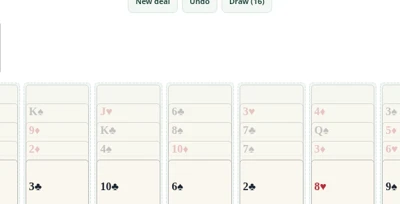
Work at your own pace. Arrange all thirteen cards into non-overlapping sets and sequences, with at least two sequences and at least one pure sequence. Return to the explanation when a decision is unclear. Take a moment to read the table. Each player receives 13 cards from two decks with one printed joker per deck. The exposed indicator determines the wild rank. Take the next action only when the current step is clear.
Two players, one computer opponent, two decks and two printed jokers. This free table allows three/four-card sets, Ace low or high without wrapping, no drop/packing action and no online matchmaking. Current hands are saved in this browser.
Give this approach a try
For a calm first round, focus on one decision. At the start of your turn, draw from the stock or take the top discard. You may not discard that same taken discard immediately. Use another round to revisit a decision.
What you are aiming for
Arrange all thirteen cards into non-overlapping sets and sequences, with at least two sequences and at least one pure sequence. The same rule applies on a phone and on a computer. Begin with the objective.
Making your moves
- Each player receives 13 cards from two decks with one printed joker per deck. The exposed indicator determines the wild rank.
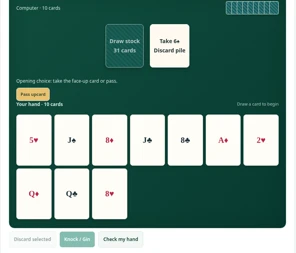
- At the start of your turn, draw from the stock or take the top discard. You may not discard that same taken discard immediately.
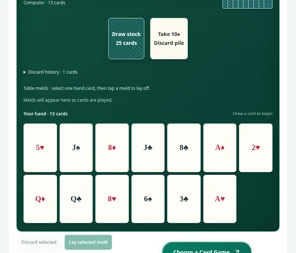
- Sort the hand. A sequence has at least three consecutive same-suit cards; a set has three or four cards of one rank in different natural suits.
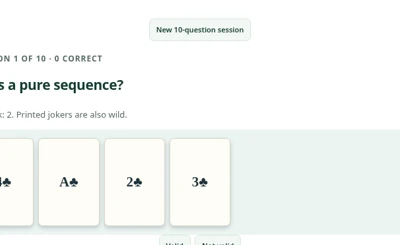
- A pure sequence uses no joker substitution. A wild-rank card used at its printed rank and suit can belong to a pure sequence.
- Select the extra card and choose Declare Rummy only when all remaining 13 cards form a valid grouping. Otherwise discard and let the computer play.
- The winner earns the other hand’s penalty, capped at 80. No pure sequence means all non-jokers count; with only one pure sequence, only pure runs are exempt; with two sequences including a pure one, other valid groups can also be exempt.
- If the stock runs out without a valid declaration, the hand is drawn. Next hand preserves the score; New match clears it.
Keyboard and screen controls
Tap a card to select it. Use the labelled pile and action buttons. Sort by rank or suit; the hand wraps onto additional rows on a phone. Return to the explanation when a decision is unclear. Use the rule sheet as a reference.
Follow the example
With 2 as the wild rank: 3♥ 4♥ 5♥; 7♠ 8♠ Joker; 9♣ 9♥ 9♦; K♣ K♥ K♦ K♠ form a valid hand. The first run is pure and the second uses a joker. Use another round to revisit a decision.
Keep this in mind
Take a moment to read the table. A group can look valid on its own while the complete hand is invalid. Do not reuse one physical card in two groups or join K–A–2. Take the next action only when the current step is clear.
Further help with the game
What is the aim?
Arrange all thirteen cards into non-overlapping sets and sequences, with at least two sequences and at least one pure sequence. Keep the active rule in mind. Use another round to revisit a decision.
How do I use the controls?
Tap a card to select it. Use the labelled pile and action buttons. Sort by rank or suit; the hand wraps onto additional rows on a phone. Take a moment to read the table. Use another round to revisit a decision.
Which format is available?
Two players, one computer opponent, two decks and two printed jokers. This free table allows three/four-card sets, Ace low or high without wrapping, no drop/packing action and no online matchmaking. Current hands are saved in this browser. Take a moment to read the table. Take the next action only when the current step is clear.
What should I check before a move?
A group can look valid on its own while the complete hand is invalid. Do not reuse one physical card in two groups or join K–A–2. For a calm first round, focus on one decision. Use another round to revisit a decision.
Can you give an example?
With 2 as the wild rank: 3♥ 4♥ 5♥; 7♠ 8♠ Joker; 9♣ 9♥ 9♦; K♣ K♥ K♦ K♠ form a valid hand. The first run is pure and the second uses a joker. Take a moment to read the table. Use another round to revisit a decision.
Can I use a joker in the pure sequence?
A printed joker cannot substitute in a pure sequence. A wild-rank suited card can count naturally at its own rank and suit. Use the rule sheet as a reference. The same rule applies on a phone and on a computer.
Can I declare with two sets and one sequence?
No. You need at least two sequences, including one pure sequence, and all 13 cards must be grouped. Work at your own pace. Take the next action only when the current step is clear.
How do Aces score?
Aces and face cards count 10 penalty points; 2–10 count their values. Printed and rank jokers count zero. Look at the complete hand before deciding. Take the next action only when the current step is clear.
What does Check my hand do?
It searches for non-overlapping groups and shows the penalty and grouping under this table’s rules. It does not play your turn. Take a moment to read the table. Use another round to revisit a decision.
Does the computer see my cards?
Its decision function uses its own hand, visible discards and public rule data, not your hidden hand or the stock order. Take a moment to read the table. Check the relevant controls before continuing.